
Bella Musica Mozarteum
Music as Europe’s Language of Peace
On 10 September, Bella Musica Mozarteum concluded its 2026 Italian tour in Padua to great acclaim. The young musicians of the Pre-College of the University Mozarteum Salzburg followed in Mozart’s footsteps across Italy, bringing together artistic excellence, historical musical culture, international exchange and social commitment.
The tour took the ensemble from Siena, Lucca and Arezzo via Rome and the Vatican to Florence, Cremona, Milan and Padua. Around 40 press articles, media reports, event announcements and international online publications accompanied the project. Coverage by Vatican News, published in numerous language editions, as well as reporting in Austrian and Italian media, achieved particularly broad reach.
A Special Day at the Vatican
The tour’s high point took place at the Vatican on 2 September. At the General Audience in St Peter’s Square, Bella Musica Mozarteum accompanied the entrance of Pope Leo XIV with Mozart’s Eine kleine Nachtmusik. The original Dalla Costa violin was heard before an audience of around 15,000 pilgrims and guests.
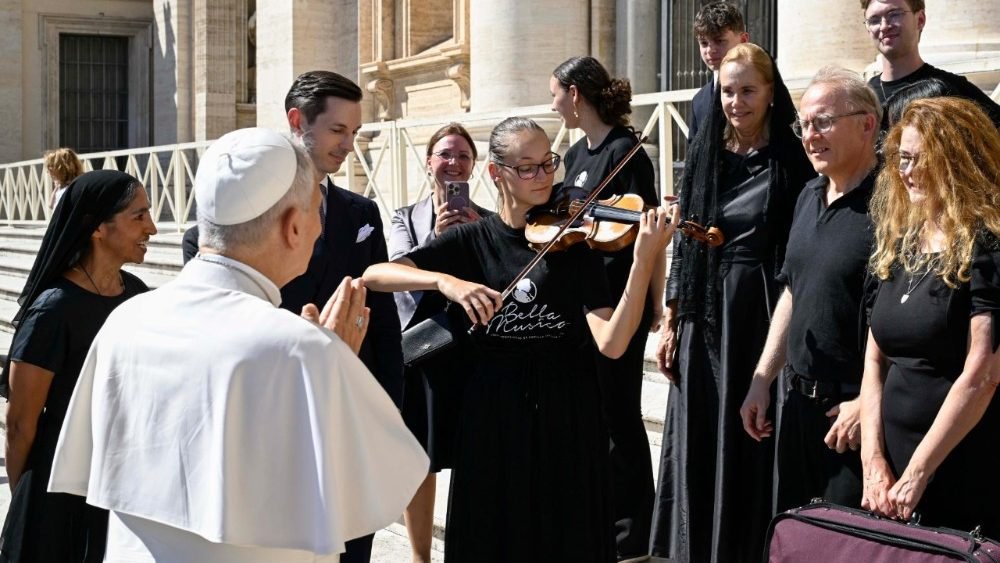
Following the audience, the ensemble had a personal meeting with the Holy Father. The Costa violin was presented to Pope Leo XIV, and Bernadette Pihusch, a Pre-College student and member of Bella Musica Mozarteum, offered him a brief musical tribute on the instrument. In a particularly moving gesture, Pope Leo XIV personally held the historic instrument once played by Mozart himself.
That same afternoon, Bella Musica Mozarteum recorded a concert programme in the historic Sala Assunta of Vatican Radio, located in the Vatican Gardens. The broadcast will air today, Saturday 12 September, at 10.00 p.m. on Vatican Radio’s programme Scrigno musicale. From mid-September, the recording will be made available to partners of the EuropeanBroadcasting Union, enabling it to reach audiences across Europe.
Mozart’s Violins as a Bridge
At the heart of the tour were two exceptional instruments from Wolfgang Amadé Mozart’s personal possession: his childhood violin and the Dalla Costa violin, Mozart’s concert violin from his Viennese years. Their first presentation in Rome made Mozart’s sonic world immediately audible in historic locations connected with his Italian biography, becoming a powerful symbol of European cultural solidarity.
“In the 270th anniversary year of Wolfgang Amadé Mozart, it is especially important to us to make his musical legacy visible and effective far beyond Salzburg. The first presentation in Rome of two original violins from Mozart’s personal possession was a powerful sign of European cultural solidarity.” Johannes Honsig-Erlenburg, President of the International Mozarteum Foundation.
“The Bella Musica Tour 2026, and especially the concert at the Vatican with the original Mozart violins, enabled an exceptionally direct encounter with Mozart’s world of sound. In doing so, the ensemble made a compelling artistic statement and continued a tradition that Mozart himself established through his appearance at the Vatican in 1770.” Linus Klumpner, CEO of the Mozarteum Foundation and Director of the Salzburg.
Mozart Museums Festival Concerts and Partnerships
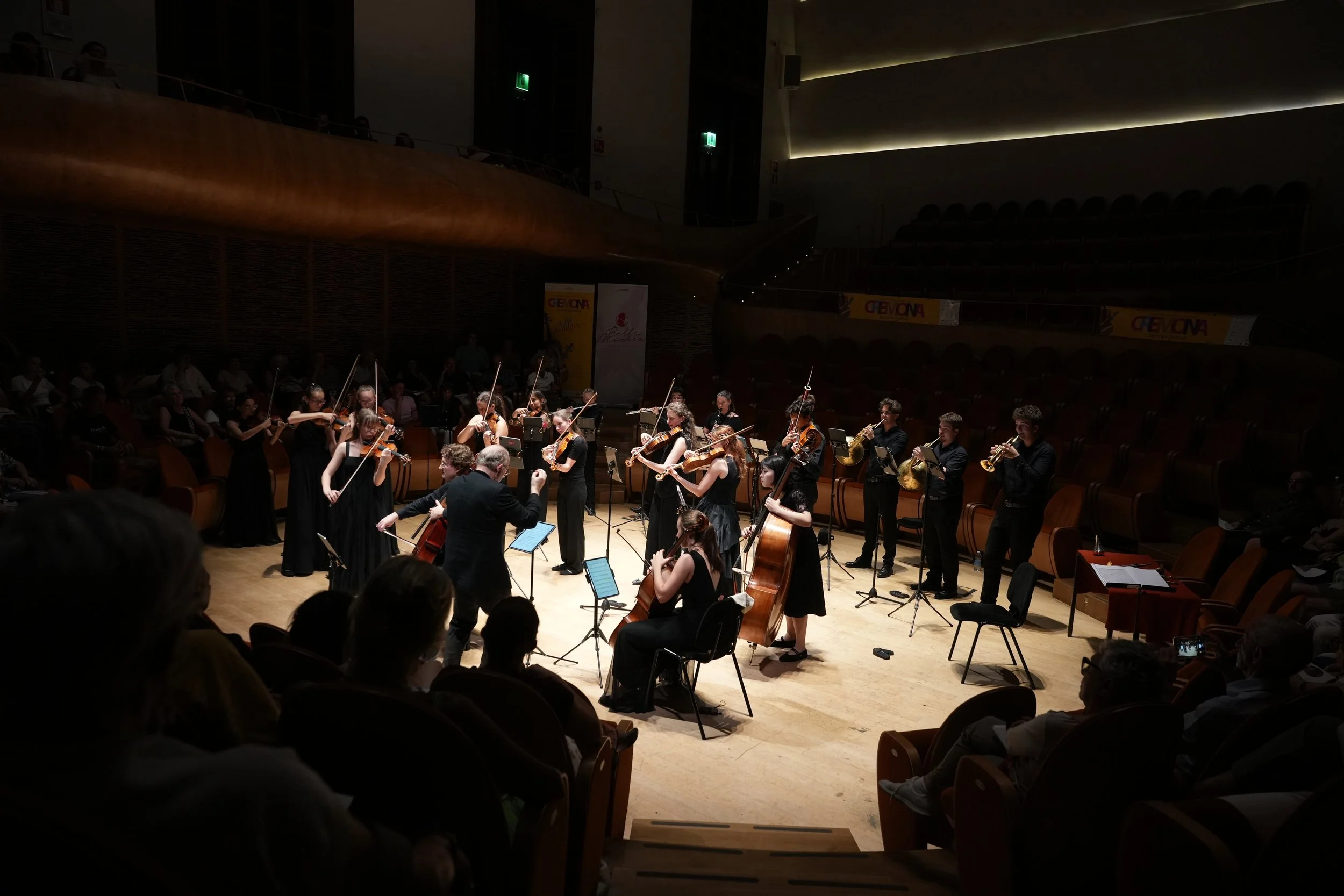
During the tour, Bella Musica Mozarteum also performed at major international festivals: the Chigiana International Festival & Summer Academy in Siena, the Cremona Summer Festival in the Auditorium Giovanni Arvedi of the Museo del Violino, and before a capacity audience in the Sala Accademica of the Conservatorio Santa Cecilia di Roma. The Cremona appearance marked the ensemble’s third consecutive invitation and was received with sustained applause. The cooperation with the Conservatorio Luigi Boccherini in Lucca and the Teatro del Giglio Giacomo Puccini was also continued.
A key partner of the tour was the European network European Mozart Ways, led by its President Maria Majno. The network provided substantial support to Bella Musica Mozarteum and opened valuable opportunities for performances and encounters at important locations associated with Mozart.
As Young Ambassadors of the European Mozart Ways, the members of Bella Musica carry forward the idea of a living European cultural heritage. The partnership brings historically significant places into dialogue with new encounters among young people, cultural institutions, audiences and local partners.
Rotary Ambassadors for Understanding
Since 2025, Bella Musica Mozarteum has held the distinction of Rotary Ambassador. The ensemble regards this honour as a mandate to connect young people through music and to make cultural understanding a lived social experience. Rotary District 1920 recognised Bella Musica as a musical ambassador for humanity, friendship and international cooperation. A visible expression of this commitment was the concert at the Pia Casa hospice in Lucca.
The focus there was not a grand stage, but direct human encounter. In Rome, too, the Rotary ideal of international understanding was put into practice: representatives of Rotary Club Roma International, Rotary Club Roma Sud and Rotary Club Salzburg-Altstadt came together for an intensive exchange.
“As Rotary Ambassadors, we understand music as a language of encounter. When young people from many countries rehearse, travel and make music together, they experience that differences need not become borders. I am deeply grateful that this tour proved so exceptional artistically, personally and in the media. To me, Bella Musica is also a project for peace: music creates listening, respect, friendship and trust.” Stefan David Hummel, Artistic Director of Bella Musica Mozarteum.
Education, Diversity and Gratitude
Bella Musica combines artistic development with a clear educational mission. In 2026, the ensemble brings together young people aged 10 to 22 with roots in Austria, Germany, Italy, Spain, Slovenia, Bosnia and Herzegovina, Hungary, Thailand, China, Korea and Iran.
Alongside musical quality, their shared work develops teamwork, self-organisation, communicative sensitivity and responsibility. Its inclusion in the Austrian Federal Ministry’s Atlas of Good Teaching 2026 affirms this approach.
“At the University Mozarteum, diversity is not an abstract idea but a lived reality. Within Bella Musica, making music together creates spaces for listening, understanding and responsibility. In this way, it becomes tangible how music connects people and makes an open, peaceful and humane coexistence possible.” Constanze Wimmer, Rector of the University Mozarteum Salzburg.
“Bella Musica exemplifies the educational mission of the University Mozarteum Salzburg: artistic ability is combined with lived pedagogical responsibility. Alongside musical quality, the shared rehearsal process fosters teamwork, self-organisation and communicative
sensitivity.” Helmut Schaumberger, Vice-Rector for Studies and Teaching, University Mozarteum Salzburg.
The ensemble extends its thanks to all private supporters, foundations, institutions and cooperation partners who made this European project for culture, education and peace possible.
Particular and heartfelt thanks go to the International Mozarteum Foundation. Its decision to entrust the young ensemble with Mozart’s childhood violin and the Dalla Costa violin from Mozart’s personal possession for this tour was by no means self-evident. This extraordinary trust enabled the young musicians to encounter Mozart’s world of sound directly. It was both a privilege and a responsibility to carry this heritage forward with care.
Special thanks are also due to the principal sponsors Dorothee Volpini de Maestri and Karin Rehn-Kaufmann. Their personal commitment and their confidence in the young musicians made a decisive contribution to the realisation of this exceptional tour, the journey of Mozart’s historic violins and the international encounters it enabled.
The ensemble also thanks the Rotary Clubs, especially RC Salzburg Altstadt, Rotary Club Roma International, Rotary Club Roma Sud and Rotary District 1920. Their support strengthens Bella Musica in its commitment to making music a tangible force for humanity, social responsibility, peace and international understanding.
Bella Musica’s 2026 tour demonstrated with great clarity that Mozart’s cultural legacy does not belong to the past. It speaks to the present and reminds us of what holds Europe together: openness, education, cultural heritage, mutual respect and the will for peace. In a world marked by international crises, Bella Musica became a visible and audible sign of lived European understanding. The young musicians are therefore not only ambassadors for Mozart, but also ambassadors for a future in which music connects people and makes peace possible.
Photos © Stiftung Mozarteum